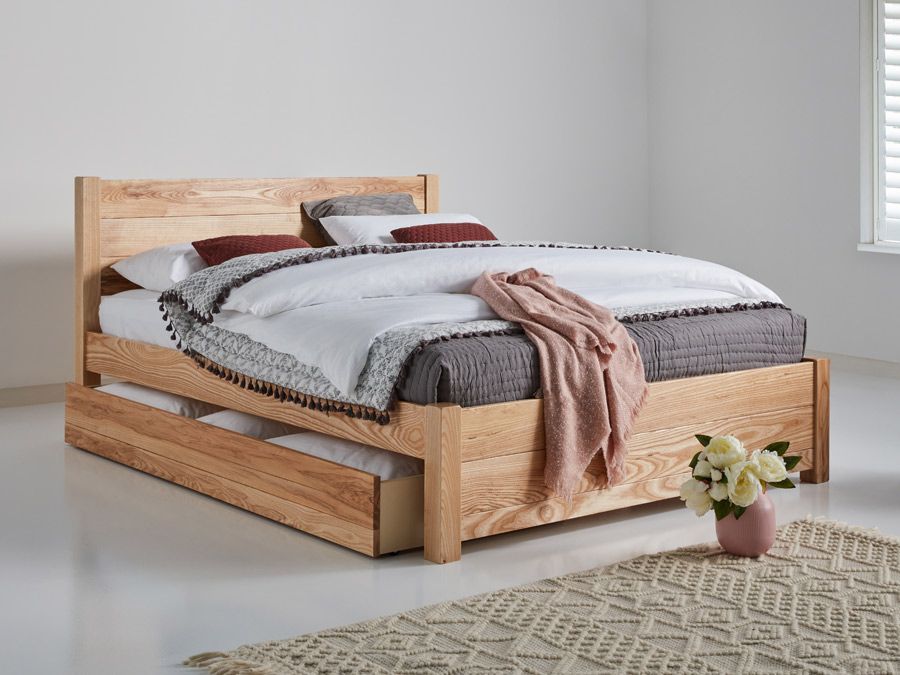
Solid wood bed frames are valued for their durability, long service life, and ability to withstand daily use over decades. This guide explains how different solid timber types perform in bed frames, comparing factors such as hardness, stability, sustainability, and suitability for UK homes.
At Get Laid Beds, we specialise in handcrafted solid wood bed frames designed to last far longer than typical mass-market alternatives. Whilst engineered woods and veneers often have a lower upfront cost, solid timber generally offers greater structural longevity, repairability, and a longer usable lifespan when properly sourced and constructed.
The purpose of this article is to help you confidently choose the most suitable wood type for your home, lifestyle, and long-term expectations, using clear comparisons and industry-standard measures where relevant.
Hardwoods are dense and long-lasting, ideal for daily use over decades. Softwoods grow faster and are more affordable, making them a flexible, sustainable choice for lighter use or creative finishes.
Hardwoods come from slow-growing trees, producing dense, durable timber. Their dense grain handles knocks, bumps, and heavy daily use with ease. Hardwoods typically last 60–100 years and generally have higher natural resistance to fire than most softwoods. These qualities make them perfect for master bedrooms, busy family homes, or anyone seeking a bed that will truly last a lifetime.
Softwoods grow faster and have a lighter, less dense grain. Pine is the most common example. Whilst less hard than most hardwoods, softwoods are highly renewable and budget-friendly. They’re ideal for guest rooms, kids’ bedrooms, or for beds you plan to stain, colour-wash, or customise. Softwoods provide a practical way to bring the warmth of solid timber into your home without the higher upfront cost of hardwoods.
When deciding between hardwood and softwood, consider how the bed will be used, the style of the room, and your long-term plans. Hardwoods are an investment in durability and longevity, while softwoods offer flexibility and affordability, with plenty of natural charm.
The Janka hardness scale is the industry standard for measuring timber durability. A higher score means a wood is more resistant to scratches, dents, and everyday wear. Whilst the Janka rating is a key factor in choosing a bed frame, overall durability also depends on timber grain, frame design, and joinery quality.
We responsibly source all our timber. Each piece is fully traceable, from the forest to your home, and meets strict legal, environmental, and ethical standards..
Here’s a detailed look at our most popular solid woods:
Solid wood type | Character profile | Janka hardness | Best for... |
Heritage, heavy grain | 1,360 | Period properties & busy family homes where durability is priority. | |
Deep, luxury, dark | 1,010 | High-end master suites, mid-century modern interiors | |
Fine, uniform, pale | 1,300 | Japandi & Scandi styles; those wanting a clean, ‘knot-free’ look. | |
Warm, smooth, reddens | 950 | Rooms with lots of natural light that will deepen its unique, warm patina. | |
Creamy, dense, smooth | 1,450 | Bright, airy modern spaces | |
Light, elegant, flexible | 1,320 | Contemporary/clean styles | |
Rich, reddish, exotic | 1,500 | Bold statement pieces; those looking for a sustainable alternative to mahogany | |
Warm, rustic, knotty | 490 | Sustainable value; guest rooms, kids’ bedrooms |
Character profile: Known for its heavy, distinctive grain and natural hard-wearing strength.
Typical structural lifespan: 60-100 years
Where we get it from: USA and Canada
Why North American oak: We specifically source it from colder regions in North America, where slower tree growth produces oak that is more stable, consistent, and slightly lighter in tone.
Why we love this wood: Oak is a cornerstone of British heritage that ages with grace, developing a deep, rich patina over the years; so your bed only gains more character the longer you own it. It is also naturally resistant to fungal and insect attacks, making it one of the most reliable and long lasting materials available.
Ideal home & style: This is a perfect choice for older or period homes. It compliments traditional architecture and is naturally resistant to the moisture and temperature changes often found in older properties.
Character profile: A dense, premium hardwood known for its deep chocolate tones and a naturally smooth, refined texture.
Typical structural lifespan: 60-100 years
Where we get it from: USA and Canada
Why we love this wood: Walnut provides an immediate sense of warmth and calm. It is one of the few timbers that achieves such a rich, dark colour without any artificial stains. Because the colour is consistent throughout the wood, it is incredibly forgiving and ages with a quiet elegance.
Ideal home & style: It best suits contemporary master suites or rooms where the bed is the focal point. Its bold profile works beautifully in minimalist spaces where the natural grain is allowed to take centre stage.
Character profile: A remarkably hard, pale timber with a tight, uniform grain that offers a crisp and clean appearance. It’s one of the few hardwoods to offer such a close to straight grain.
Typical structural lifespan: 60-100 years
Where we get it from: Croatia and Germany
Why we love this wood: Beech is a dependable, no-nonsense choice. It is a heavy and dense material that is highly favoured by our craftsmen for its consistent quality and workable grain. Resistance to gouging, chipping, and general wear ensures the surface remains pristine over time, even with the knocks of daily life. Choosing a beech timber guarantees a bed frame that stays looking new for decades.
Ideal home & style: It best suits minimalist or Scandi-inspired interiors where clean lines and a neutral palette are preferred.
Character profile: A light, elegant timber with a prominent grain and a naturally resilient structure. It is prized for having one of the best weight to strength ratios of any hardwood and is naturally odour free.
Typical structural lifespan: 60-100 years
Where we get it from: USA and Canada
Why we love this wood: Ash is prized for its incredible stability, it being naturally odour free, and for having one of the best weight to strength ratios of any hardwood. Whilst most timber moves as the seasons change, which is what causes a frame to creak, the natural elasticity of Ash allows it to absorb these shifts silently. It is a quiet, reliable choice for those who want a bed that will not groan when the room temperature fluctuates.
Ideal home & style: It is ideal for contemporary spaces and modern loft conversions where temperature fluctuations are common.
Character profile: A rich, reddish brown wood with a fine texture and high density.
Typical structural lifespan: 60-100 years
Where we get it from: West Africa (mainly from Cameroon, Ivory Coast, and Ghana)
Why we love this wood: Sapele is an exceptional choice for those who admire the look of mahogany but want a more sustainable alternative. It is the hardest wood we offer, providing the best protection against the dents and scratches of a busy home. We love it because it offers a luxurious, established look whilst remaining a conscious choice for the environment.
Ideal home & style: Best suited for bold statement pieces in large, well lit bedrooms where you want the bed to be the focal point.
Character profile: A very dense, creamy timber with a smooth and almost silk like grain.
Typical structural lifespan: 60-100 years
Where we get it from: USA and Canada
Why we love this wood: Maple brings a bright and airy feel to a room without compromising on durability. It is the same resilient timber trusted for high impact items like baseball bats and bowling pins, providing a level of robustness that is rarely found in domestic furniture. We love it because it offers the perfect balance of a delicate, clean appearance with a surprisingly heavy and robust nature.
Ideal home & style: It complements bright, modern spaces and minimalist apartments that value clean lines and natural light.
Character profile: Known for its smooth texture and warm red hues that deepen and enrich as they are exposed to natural light.
Typical structural lifespan: 60-100 years
Where we get it from: USA and Canada
Why we love this wood: Cherry offers a beautiful and unique ageing process where the timber matures and gains a deeper glow the longer you own it. It is a refined, honest choice for those who appreciate seeing the natural character of their furniture evolve over time.
Ideal home & style: It best suits classic, traditional interiors and homes with plenty of natural light to showcase the changing tones of the wood.
Character profile: A lighter timber with characterful knots and a warm, natural honey tone.
Typical structural lifespan: 20-30 years
Where we get it from: Finland and Sweden
Why we love this wood: Pine is a versatile and honest choice. While the grain of a hardwood is often left natural, pine acts as a perfect canvas for your personal style. It takes stains and colour washes remarkably well, which is why we recommend this timber if you choose one of our eight colour finishes. It is a practical, sustainable way to bring the warmth of solid timber into your home.
Ideal home & style: It is perfect for guest rooms, kid’s bedrooms, or any space where you are looking for a specific colour matched aesthetic. Pine offers an excellent balance of value and craftsmanship for any room in your home.
When considering the cost of a new bed, the upfront price is only half the story. A bed made from engineered wood or veneer may seem like a bargain, but if it requires replacement every few years because the joints have weakened, it becomes an expensive and frustrating habit.
We believe in a different approach. By choosing solid timber, you are making a buy once decision. To make comparison easier, we group our sustainable woods into three broad levels of investment.
Good: Scandinavian Pine - budget-friendly, sustainable, ideal for guest rooms. Softer wood, lifespan ~20–30 years; requires care to avoid surface marks.
Better: Walnut & Cherry - premium hardwoods with unique ageing, depth of colour. Lifespan ~60–100 years; slightly softer than densest timbers but far more durable than softwoods.
Best: Ash, Beech, Oak, Maple, Sapele - top-tier hardwoods with highest Janka scores, maximum resistance to dents/scuffs, lifespan 60–100 years; built to last generations.
Choosing a solid wood frame is a decision to step away from the fast-furniture cycle. Because our beds are handcrafted in the UK and backed by an 11-year guarantee, the cost per year is significantly lower than disposable alternatives.
British housing presents a diverse range of internal climates, from the damp, solid walls of period properties to the rapid temperature spikes of modern loft conversions. These conditions put constant stress on furniture, making it essential to choose timber that can cope with seasonal moisture and temperature shifts.
Risk: Engineered wood - lifespan 5–10 years; prone to moisture and heat; can peel, swell, or creak.
Better: Pine is naturally resilient and handles most UK environments well. It is a dependable choice, although it remains more reactive to moisture than hardwoods.
Best: Dense hardwoods such as oak, ash, and beech are the most stable options. Their tight grain is naturally resistant to warping and moisture, ensuring the frame remains silent and rigid all year round.
For a deeper look at how factors like moisture, temperature changes, and frame stability affect different timbers in UK homes, see our dedicated guide.
Choosing solid wood is typically the greenest option for your bedroom. It requires no high-VOC glues, which are often found in engineered woods. Furthermore, solid timber lasts generations, drastically reducing waste. What’s more, at the end of its life, veneer woods tend to end up in landfill, but solid timber frames are fully recyclable.
We track our wood from the point of source right through to delivery, ensuring the highest ethical standards for workers and only using sustainably harvested timber. To further reduce our carbon footprint, every bed is handmade in our workshops in Leicestershire and delivered straight to you. We deliver our beds flat-packed to minimise transport emissions, and for ease, we can even assemble the bed in the room of your choice - simply select the assembly service at checkout.
The quality of your mattress and the standard of your bed frame are intricately linked, and together they have a significant impact on the quality of sleep you enjoy. A poor-quality mattress can actually damage a bed frame if it does not distribute weight evenly, but a flimsy frame is equally damaging to a mattress.
Solid wood prevents slat-sag, which ensures your mattress remains level. This is vital for spinal alignment and prevents the mattress components from wearing prematurely. Our frames are designed to resist racking (side-to-side wobble), providing a silent, sturdy foundation for any mattress type.
Our top tip: Heavier mattress types, such as latex, can put additional strain on the bed frame. We would recommend a hardwood frame for these, as it offers the extra support and density required to handle the weight over time.
Selecting the right timber is more than an aesthetic choice; it is an investment in the quality of your sleep and the health of the planet. From the sustainable flexibility of pine to the timeless character of our heritage hardwoods, every choice we offer is built to endure. This is supported by our 11 year guarantee on all bed frames. By moving away from disposable furniture and embracing the durability of solid wood, you are choosing a bed that will remain a cornerstone of your home for years to come.

WE VALUE YOUR PRIVACY
We use cookies to enhance your browsing experience, serve personalised ads or content, and analyse the traffic with 3rd party services. By clicking ‘Accept’, you consent to our use of cookies, visit our Privacy Policy and our Cookie Policy for more info.
Please select one of the delivery countries below or navigate to our UK website for UK delivery options.
Note: International shipping prices are charged per bed rather than per order. This is due to the bulky nature and weight of these products.