Clever phrasing often hides cost-cutting measures where you think you’re getting one thing, but in reality, you’re getting something inferior. We believe accountability and transparency should be the industry standard, not the exception; that’s why we want to help you understand how some products ‘stretch the truth’, how we back up each claim for your total peace of mind, and handy tips to spot whether you’re getting the genuine quality and value for money you’re paying for.
When a retailer describes a product as ‘solid wood’ or uses the broader term ‘wooden beds’ or ‘oak beds’, you likely expect every component to be made from genuine, continuous timber. In reality, what you might be getting is:
Wood veneer: Found more with broader terms like ‘wooden beds’ and where a specific wood is mentioned e.g. walnut or ash, the bed could in fact be made from chipboard or MDF but have a real wood veneer glued on top.
Hybrid builds: Claims like ‘made from solid wood’ can mean that only some parts are made from solid wood, with other parts using wood veneer to reduce production costs.
Every structural element of our bed frames is crafted from 100% solid timber. From the headboard to the slats, we use the real thing. The only non-timber components in our frames are the high-grade nuts and bolts used to ensure your bed remains squeak-free and sturdy for a lifetime.
Check the End Grain: Real timber has a grain that continues over the edge of the wood; if the pattern stops or looks like a sticker, it is likely to be veneer.
Weight and Temperature: Solid wood feels substantial and remains room temperature to the touch, whereas veneer laminates often feel cold, plastic-like, and somewhat lighter.
Greenwashing is a common practice across multiple industries and the bed and furniture market unfortunately is no different. Terms like ‘green’, ‘sustainable’, and ‘eco-friendly’ are banded around meaning that claims are often:
Unsubstantiated - This could include things like not providing evidence, quantifiable facts, or saying timber is sustainably-sourced, without transparent traceability around where the wood comes from.
Exaggerated - Focusing on a minor green detail, such as recyclable packaging, to distract from the environmental cost of mass-produced, flimsy beds that are not designed for longevity.
Our approach focuses on three key areas: the materials we use, how we deliver your bed, and how we give back.
Opting for solid timber over engineered alternatives means our beds often outlast them, which significantly reduces waste. At the end of its life, solid wood is also fully recyclable, allowing it to enter the circular economy rather than landfill.
We pride ourselves on tracing every tree we use, from managed forests to our workshop. This ensures our timber is sustainably harvested and that no workers are exploited within our supply chain. We source our solid timber from the following regions:
USA and Canada - Oak, walnut, ash, maple, and cherry.
Croatia and Germany - Beech
West Africa (primarily Cameroon, Ivory Coast, and Ghana) - Sapele (which is a more sustainable alternative to mahogany)
Finland and Sweden - Pine
Every bed is made to order in our Leicestershire workshop, so nothing is produced unnecessarily. From there, it travels directly to your home (without passing through warehouses or resellers), in a space-efficient, flat-packed design that allows us to make the most of every delivery. By reducing both overproduction and unnecessary transport, we keep the overall carbon footprint of each bed as low as possible.
To date, we have planted over 115,000 trees, primarily in Kenya, through the International Tree Foundation. This project focuses on:
Ecosystem restoration - Helping to rewild habitats to support local biodiversity and planting threatened tree species.
Improve farming outcomes - Integrating trees within agricultural systems to boost crop yields and enhance soil health for local farmers.
Carbon capturing - Each tree planted removes carbon from the atmosphere, helping to offset the footprint created by transporting wood from our managed forests to our workshop and eventually to your home.
While it is a common misconception that they’re the same thing, there is a distinct difference between the two. Handmade means it is entirely made by hand, whereas handcrafted uses some machinery within its production process.
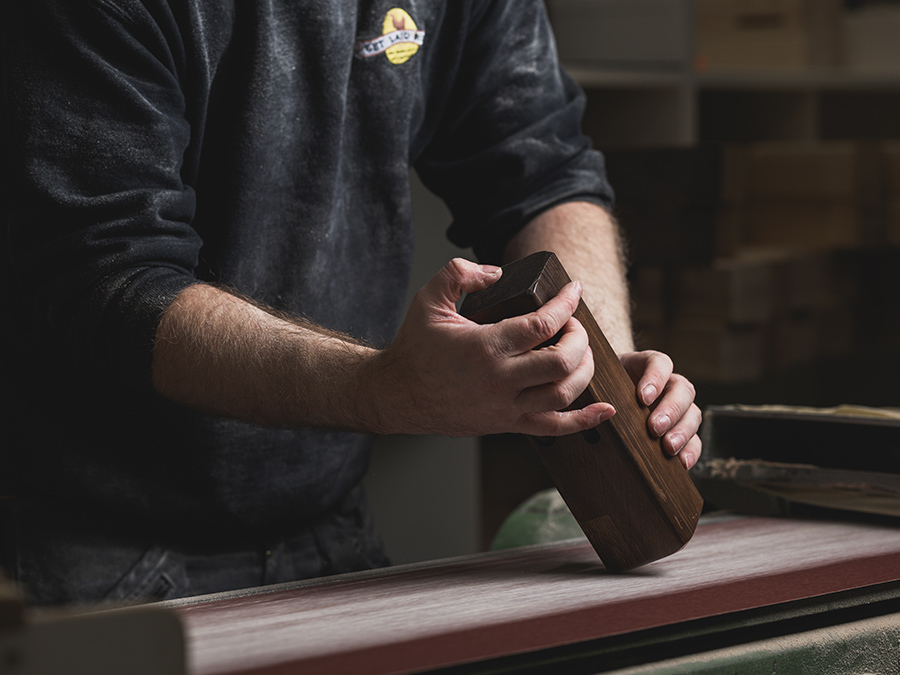
We have a 17-step process that provides the consistency of machine-made beds, with the individual character that makes handmade beds so appealing. For example, we use a machine to create the mortise and tenon joints as they create a smaller tolerance that a human hand struggles to consistently replicate. This makes our frames more rigid and less prone to wobbling over time. Other elements like staining, finishing, and some sanding are done by hand for that authentic artisan feel. This is why we refer to our beds as handcrafted rather than handmade.
Some competitors use the term to describe mass-produced items that were simply boxed by a human. If a bed exclusively uses flimsy plastic cam-locks or thin metal brackets instead of proper wood-to-wood joinery, it likely isn't a handcrafted piece.
We don't just sell beds; we provide the centrepiece for your bedroom. Our commitment to accountability means:
Full transparency - From what our beds are made from, through to how we make them for you.
Direct workshop pricing - No retail markups, just fair prices for exceptional sustainable materials..
An 11-Year Guarantee - We don’t just claim quality; we back it up for over a decade.
WE VALUE YOUR PRIVACY
We use cookies to enhance your browsing experience, serve personalised ads or content, and analyse the traffic with 3rd party services. By clicking ‘Accept’, you consent to our use of cookies, visit our Privacy Policy and our Cookie Policy for more info.
Please select one of the delivery countries below or navigate to our UK website for UK delivery options.
Note: International shipping prices are charged per bed rather than per order. This is due to the bulky nature and weight of these products.